
Strait of Hormuz Closed Again: What It Means for Indonesia’s Palm Oil, Coal, Energy & Tech Industries
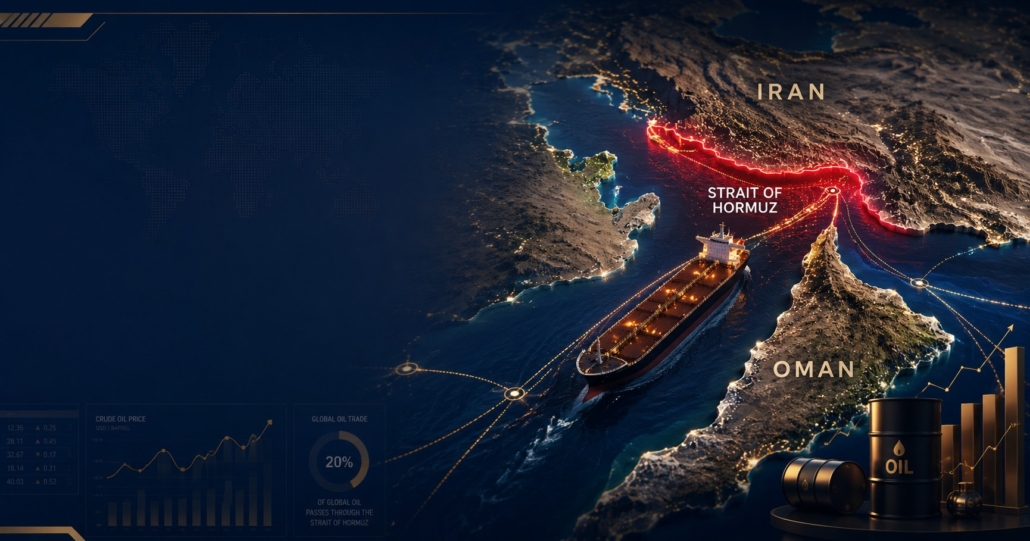 © GAN Kapital Group (AI-generated illustration)
A Critical Global Trade Route Is Under Pressure Again
The Strait of Hormuz has once again become the focus of global markets after renewed tensions between Iran and the United States escalated in July 2026. Iran’s Islamic Revolutionary Guard Corps (IRGC) announced an indefinite closure of the strategic waterway, raising concerns across the energy, logistics, and commodity sectors.
Although the conflict is taking place thousands of kilometers from Indonesia, its effects could ripple across global supply chains. Nearly 20% of the world’s oil trade passes through the Strait of Hormuz each day, making any disruption a significant concern for businesses that rely on international trade, imported materials, and stable energy prices.
For Indonesia, industries such as palm oil, coal, energy, logistics, and technology are among those most likely to feel the indirect impact.
Why Is the Strait of Hormuz So Important?
The Strait of Hormuz is one of the world’s most strategically important maritime routes. Located between Iran and Oman, it connects the Persian Gulf to the Gulf of Oman and serves as the main shipping lane for crude oil and liquefied natural gas (LNG) exports from Saudi Arabia, the UAE, Kuwait, Iraq, Qatar, and other Gulf countries.
Because such a large portion of the world’s energy supply passes through this narrow waterway, any disruption can immediately affect:
- Global oil prices
- Shipping and insurance costs
- International logistics
- Commodity markets
- Business confidence
Even temporary closures can increase uncertainty throughout the global economy.
Timeline: How the Iran–US Conflict Escalated
The latest developments unfolded over several months:
- Late February 2026: Military conflict erupted between Iran and the United States, significantly increasing tensions across the Gulf region.
- June 2026: A Pakistan-mediated ceasefire temporarily reopened the Strait of Hormuz.
- Early July 2026: Fighting resumed after Iran accused the United States of violating the peace agreement.
- July 12–16, 2026: Iran’s IRGC announced an indefinite closure of the Strait of Hormuz, demanding greater control over the strategic waterway.
These developments have heightened concerns among governments, investors, and businesses around the world.
How Could the Strait of Hormuz Closure Affect Indonesia?
Although Indonesia is not directly involved in the conflict, its economy remains closely connected to global commodity and logistics markets.
Energy Sector
Higher geopolitical risks typically lead to increased volatility in global oil and gas prices. Rising energy costs can influence fuel prices, transportation expenses, manufacturing operations, and overall business costs.
Coal Industry
Indonesia is one of the world’s leading coal exporters. While coal shipments do not primarily pass through the Strait of Hormuz, rising freight rates, marine insurance premiums, and shipping disruptions could increase export costs and affect trade competitiveness.
Palm Oil Industry
Indonesia’s palm oil sector may experience higher logistics costs as international shipping becomes more expensive. At the same time, fluctuations in competing vegetable oils and energy prices could influence global demand and pricing for crude palm oil (CPO).
Technology Industry
Technology companies depend on global supply chains for semiconductors, electronic components, and imported equipment. Geopolitical uncertainty may contribute to shipping delays, currency volatility, and higher procurement costs.
What Should Businesses Do?
Periods of geopolitical uncertainty call for preparation rather than panic. Businesses can strengthen resilience by adopting several strategic measures.
Hedge Key Risks
Manage exposure to volatile energy and commodity prices where appropriate.
Diversify Suppliers
Reduce dependence on a single supplier, market, or logistics route.
Strengthen Financial Buffers
Prepare for potential increases in freight, insurance, and operational costs.
Monitor Global Developments
Timely information enables businesses to respond more quickly to changing market conditions.
Why Monitoring Global Events Matters
Today’s business landscape is more interconnected than ever. A geopolitical event in one region can quickly influence commodity prices, logistics networks, exchange rates, and investor confidence worldwide.
Organizations that continuously monitor global developments are generally better positioned to manage risk, adapt their strategies, and identify opportunities amid uncertainty.
Conclusion
The renewed closure of the Strait of Hormuz serves as a reminder that geopolitical developments can have far-reaching consequences beyond the Middle East.
While the long-term outcome remains uncertain, businesses in Indonesia should pay close attention to potential impacts on energy prices, logistics costs, commodity markets, and global supply chains.
At GAN Kapital Group, we continuously monitor global economic and geopolitical developments to deliver timely business insights that help organizations navigate uncertainty and make informed strategic decisions.
Frequently Asked Questions (FAQ)
Why is the Strait of Hormuz important?
The Strait of Hormuz is one of the world’s most critical maritime trade routes, handling around 20% of global oil shipments every day.
How could the Strait of Hormuz closure affect Indonesia?
Although Indonesia is not directly involved, higher oil prices, increased shipping costs, and global supply chain disruptions could affect industries such as palm oil, coal, energy, logistics, and technology.
Which industries are most affected?
The sectors most likely to experience indirect impacts include energy, coal, palm oil, logistics, manufacturing, and technology.
What should businesses do during geopolitical uncertainty?
Businesses should diversify supply chains, strengthen financial resilience, monitor geopolitical developments, and prepare for potential increases in operational costs.
Sources
 © Gan Kapital Group (GK)
